
The earliest Christians lived with an immediate expectation of Christ’s return. This hope was understandable: the Gospel was spreading rapidly across the Roman Empire, while at the same time believers faced intense persecution from Rome. The church longed for Christ’s return with great anticipation.
The Eschatology of the Early Church
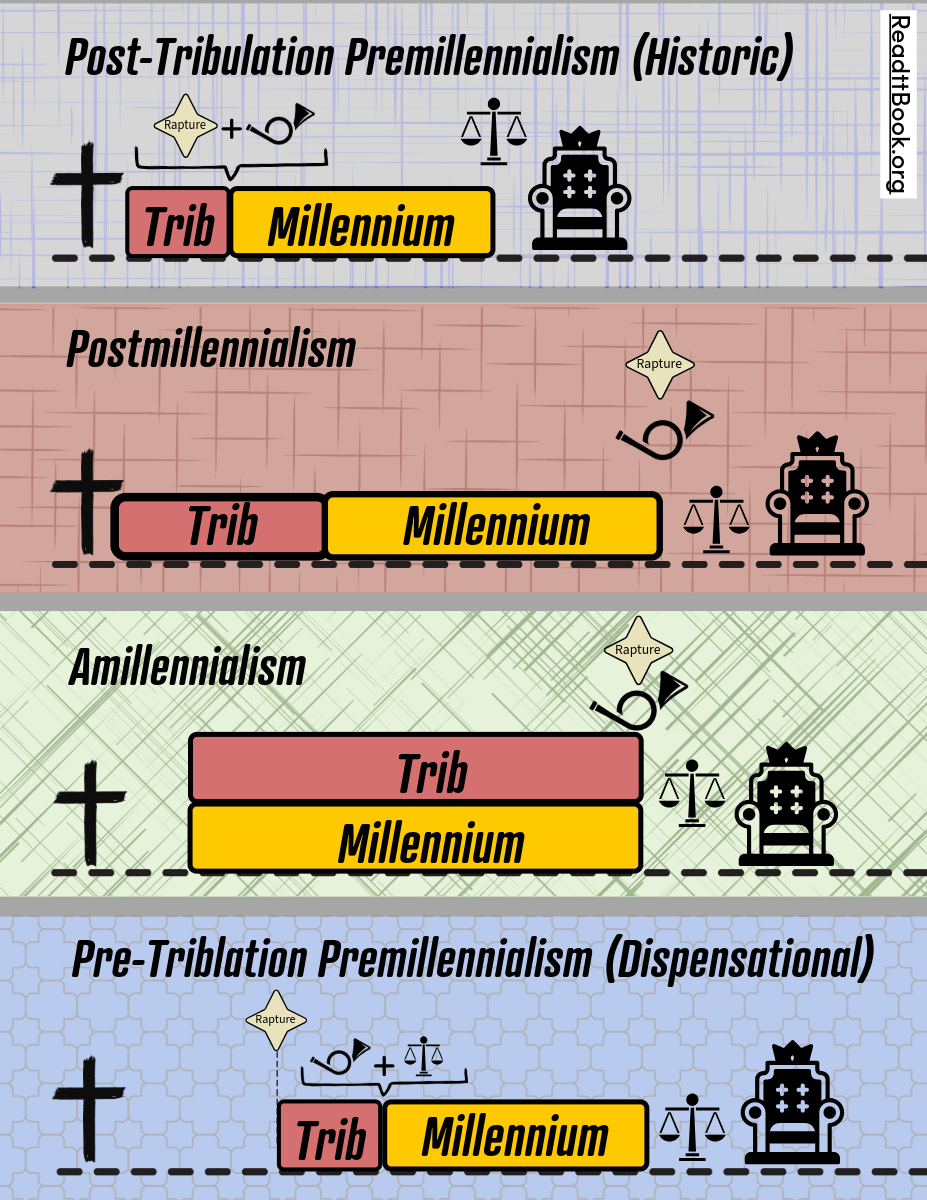
The eschatology of the early church is often described as Historic Post-tribulation Premillennialism. In simple terms, they believed they were already living in the midst of tribulation. The Gospel was reaching the ends of their known world, and they expected Christ to return soon—rapturing the elect, defeating Satan and his intermediaries, and ushering in a literal thousand-year reign on earth. After that, they anticipated the final judgment and the eternal rule of Christ.
A Shift in Expectation
Not until the 300s A.D. did the church’s view begin to transform into a near/distant future return of Christ. By near/distant, this means a belief that Christ could return at any moment (near), or at some point in the distant future.
Out of this shift, three distinct views of eschatology eventually emerged (though these formal names developed much later):
- Historic Post-tribulation Premillennialism
- Postmillennialism
- Amillennialism
The Dominant Views: Postmillennialism and Amillennialism
From the mid-300s through the early 1900s, Postmillennialism and Amillennialism became the dominant positions in the church.
Postmillennialism
Postmillennialism was characterized by optimism. Postmillennialists believed that persecution would gradually decline as the Gospel spread, eventually leading to a “Golden Age” in which the vast majority of humanity would come to faith in Christ before His return.
Amillennialism
Amillennialism, by contrast, took a more sober view of human history. Amillennialists believed that tribulation would continue until Christ’s return. They understood the “Millennium” not as a literal thousand-year reign, but as a symbolic description of the church age, spanning from Christ’s ascension to His second coming.
They viewed tribulation and Christ’s reign as occurring concurrently, lasting from His ascension until His return.
The Rise of Pre-tribulation Premillennialism
The horrors of World War I became a breaking point for the optimism of Postmillennialism, and the view largely fell out of favor. As the church wrestled with a more bleak view of humanity’s prospects before Christ’s return, a fourth orthodox eschatological view emerged: Pre-tribulation Premillennialism.
John Nelson Darby is often credited as the “father” of dispensationalism, though his theology differed in many ways from what later developed. The version of dispensationalism most Western evangelicals know today was popularized by Cyrus Scofield through the Scofield Study Bible.
The Central Truth We Share
Perhaps this all feels overwhelming. I pray the charts that follow may help clarify the differences. But in the end, the central truth is simple: Christ is coming again.
When He does, He will judge every person as either righteous or unrighteous.
The righteous will be declared so not on their own merit, but through faith in Jesus Christ (Ephesians 2:8–9). They will share in the eternal glory He secured for His people, enjoying His everlasting rule and the presence of God (Revelation 21:1–7).
The unrighteous will face the eternal wrath of God, joining Satan and his demons in everlasting torment and separation from God (Revelation 21:8).
Unity Amid Differences
All four views are considered orthodox, and we should exercise Christian charity in any differences we have with one another concerning eschatology.
Though the views differ greatly, this is where every eschatological view ultimately converges: the sure return of Christ and His eternal reign.
Of this we can unite around—a call to be prepared and to anticipate with great gladness the return of King Jesus.


