
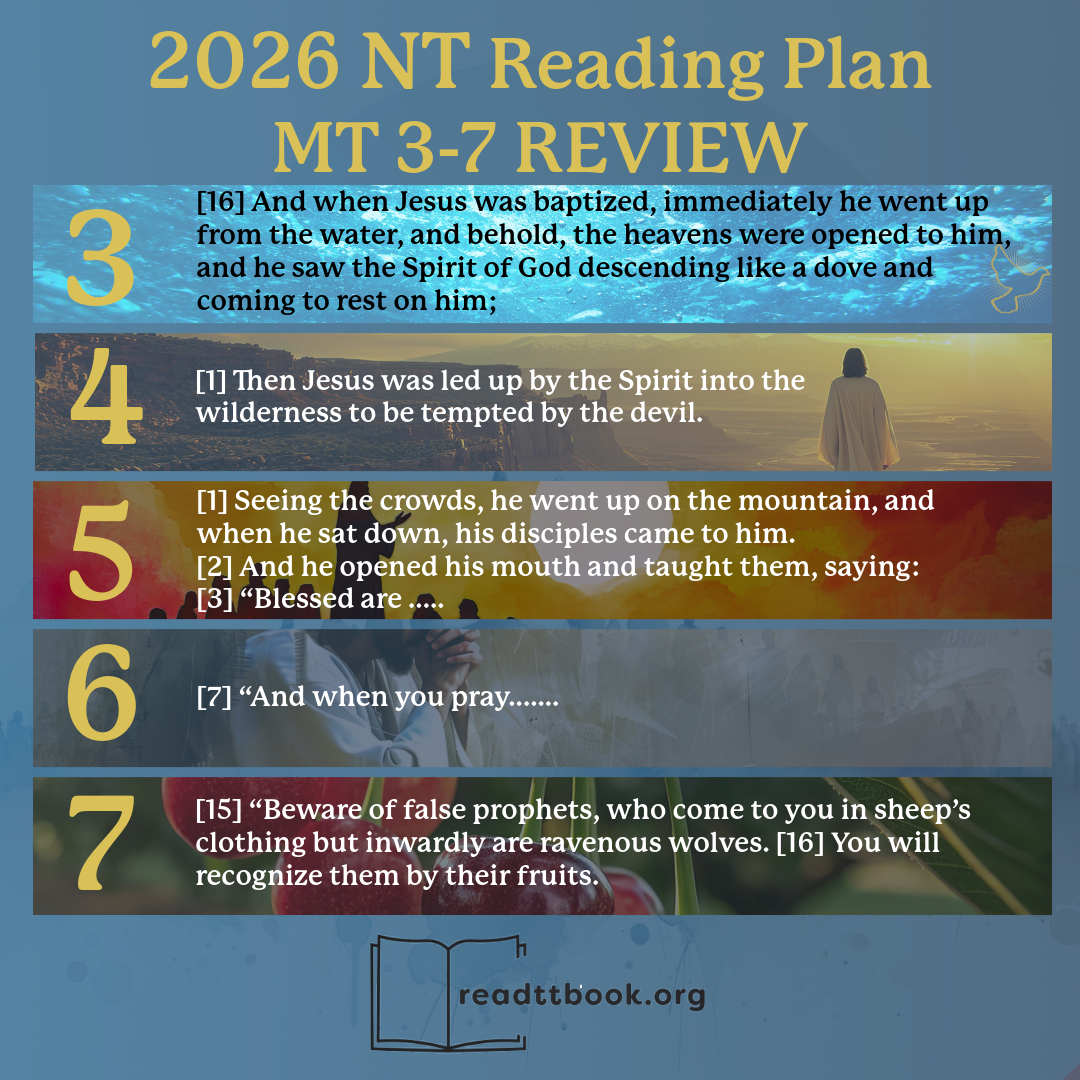
As you think back on what you have read this week, remember Matthew’s purpose in writing his Gospel: to proclaim that Jesus Christ is the promised Messiah.
We see this clearly in the Old Testament prophecies that Matthew directly connects to Christ throughout the opening chapters of his Gospel. But we should not neglect the mounting evidence Matthew presents beyond those prophecies. We see the Heavenly Father’s proclamation at Christ’s baptism, Satan’s recognition of who Christ is during the temptation, Jesus’ own proclamation to “repent, for the kingdom of heaven is at hand,” along with His miracles and authoritative teaching.
In the Sermon on the Mount, we see even more clearly that Christ’s kingdom is drastically different from the kingdom of man. Here, Matthew gives us a glimpse of the growing tension that will eventually lead to the crucifixion of Christ at the hands of the Jewish religious leaders—the very ones Jesus describes as trees bearing bad fruit.
Matthew’s message is unmistakable: Jesus is the Messiah. His kingdom is fundamentally different from the systems of this world.
“And when Jesus finished these sayings, the crowds were astonished at his teaching, for he was teaching them as one who had authority, and not as their scribes.”
Matthew 7:28–29
Reflection Questions
- What evidence does Matthew provide in chapters 3–7 that Jesus is the promised Messiah?
- Why is the Father’s proclamation at Jesus’ baptism so significant for understanding who Christ is?
- In what ways does the Sermon on the Mount reveal how different Christ’s kingdom is from the kingdom of this world?
