
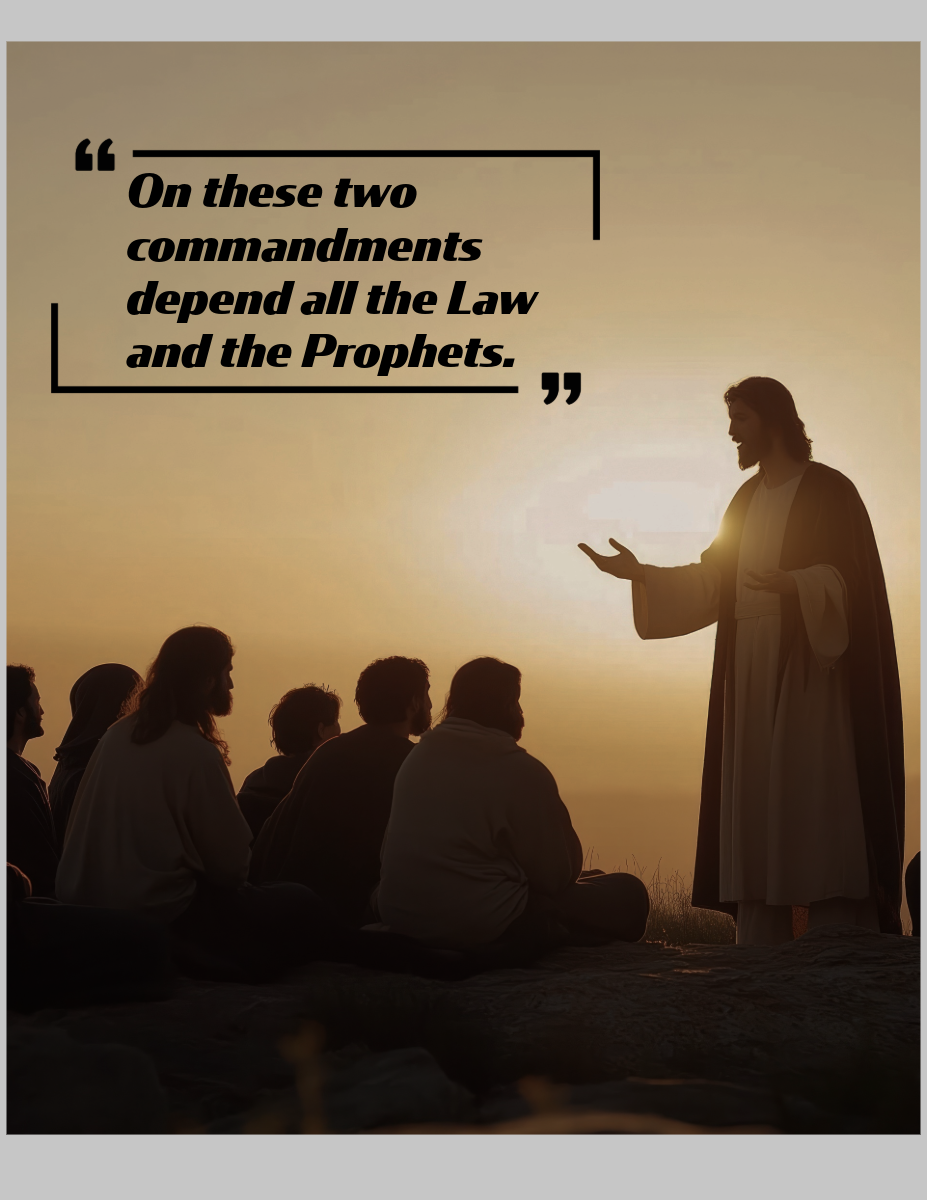
“Love God, Love Others.” It makes for a catchy mission statement. It is a simple summary of Christ’s words concerning the greatest commandment in Matthew 22.
We must admit, however, that it can sound a little vague. It leaves many questions unanswered. It allows room for a wide range of interpretations. The statement itself does not explain what love is, how we are to love, or who the “others” are that we are called to love.
Even when we turn to the passage itself, Christ’s words—taken at face value—may seem to offer limited guidance. So did Christ, or Matthew who recorded this exchange, leave us with a vague answer open to interpretation? Or is there far more here than first meets the eye?
The Greatest Commandment: The Passage
But when the Pharisees heard that he had silenced the Sadducees, they gathered together. And one of them, a lawyer, asked him a question to test him. “Teacher, which is the great commandment in the Law?” And he said to him, “You shall love the Lord your God with all your heart and with all your soul and with all your mind. This is the great and first commandment. And a second is like it: You shall love your neighbor as yourself. On these two commandments depend all the Law and the Prophets.”
— Matthew 22:34–40
I submit that there is much more here than meets the eye. Christ did not give us a vague platitude; He gave us the living Word of God. If we are to truly understand His answer—or Matthew’s faithful recording of it—we must examine the context of this passage.
When we do, we find that Christ’s words carry far more objective instruction than a surface-level reading suggests. These insights are not hidden; they are plainly visible to those who are willing to look. And that is what I invite you to do as we walk together through this passage.
The Context of the Gospel According to Matthew
The first step in studying any passage is to consider the context of the book in which it appears. This is why book overviews are so valuable when beginning a new book of Scripture.
Matthew’s primary purpose is clear: to present Jesus Christ as the long-promised Messiah—the One who fulfills God’s covenant with Abraham and David to bless the nations through their offspring (singular). Every word and argument in Matthew aligns with this purpose.
Some key background details help frame our reading:
- Written by Matthew, a former tax collector
- One of the Twelve, making him an eyewitness
- Written primarily to a Jewish audience (or those well-versed in the Old Testament)
- Likely written in the late 50s to early 60s AD
Context of Matthew 22: Rising Tension
Leading up to Matthew 22, we see mounting tension between Jesus and the Jewish religious leaders:
- Jesus enters Jerusalem and receives a king’s welcome (Mt 21:1–11)
- He cleanses the temple and drives out the money changers (Mt 21:12–17)
- His authority is challenged by the religious leaders (Mt 21:23–27)
- He tells a series of parables that condemn those leaders (Mt 21:28–22:14)
- The leaders seek a way to arrest Him but fear the crowds (Mt 21:46)
Matthew tells us plainly that they withdrew and devised a scheme to “entangle” Jesus in His words (Mt 22:15). This scheme results in a series of questions designed to discredit Him publicly or produce grounds for arrest.
A Crucial Observation
Matthew—a Jewish man—is writing to a Jewish audience. Jesus is questioned by a Pharisee lawyer (an expert in the Law) in Jerusalem, before a Jewish crowd. All involved share a deep familiarity with the Old Testament.
When Jesus answers, He quotes Deuteronomy 6:5 and Leviticus 19:18b. Everyone present would immediately recognize not only these verses, but their broader contexts. If we are to understand Christ’s words as they did, we must also understand those contexts.
Love God: Deuteronomy 6
“You shall love the Lord your God with all your heart and with all your soul and with all your mind.”
This verse was not randomly selected. Deuteronomy 6 is known as the Shema, the central confession of Judaism, recited daily and forming the heart of Jewish worship.
When we read Deuteronomy 6 in full, we see that God does more than command His people to love Him—He explains how to love Him:
- 6–7: Treasure and teach His Word
- 7–9: Center His Word in daily life and the home
- 10–12: Remember God’s salvation and deliverance
- 13: Fear and trust the Lord
- 14–15: Remain faithful; avoid spiritual adultery
- 16–19: Obey His commands
- 20–23: Testify to God’s saving work to future generations
- 24–25: Teach obedience as righteousness
God never commanded love without instruction. Love for God begins with treasuring His Word, obeying His commands, teaching His truth, and remembering His saving grace. This is the context Jesus invokes, and it must inform our understanding as well.
If we love God, we will treasure His Word, obey Him, teach our children and grandchildren, and testify to the deliverance from sin He has graciously provided.
Love Others: Leviticus 19:18b
The lawyer asked for one commandment, yet Jesus gave two:
“You shall love your neighbor as yourself.”
Leviticus 19:18b serves as a summary of a broader section (Lev 19:9–18) addressing how God’s people are to treat others. These commands include care for:
- The poor
- The sojourner
- Neighbors
- Workers
- Both the rich and the vulnerable
While not exhaustive, the message is unmistakable: treat everyone with love. Treat others as you would want to be treated.
Jesus’ Repeated Emphasis in Matthew
This is the third time Jesus quotes Leviticus 19:18 in Matthew’s Gospel. The first two appear in the Sermon on the Mount:
“You have heard that it was said, ‘You shall love your neighbor and hate your enemy.’ But I say to you, Love your enemies and pray for those who persecute you…” (Mt 5:43–44)
“So whatever you wish that others would do to you, do also to them, for this is the Law and the Prophets.” (Mt 7:12)
In Matthew 5, Jesus corrects the religious leaders’ sinful addition—“and hate your enemy.” That phrase appears nowhere in Leviticus 19 and directly contradicts its message. Jesus’ conclusion is striking: those who truly love this way show themselves to be children of the Father.
In Matthew 7 and again in Matthew 22, Jesus ties loving others to the fulfillment of “the Law and the Prophets.”
Love God = Love Others
The context is impossible to ignore. Jesus is questioned by a Pharisee—part of the very group that distorted God’s Word to justify themselves.
God’s command to love others. That man would have confidently claimed to love God, yet Jesus repeatedly teaches that genuine love for God transforms a person to love others.
“On these two commandments depend all the Law and the Prophets.”
The religious leaders claim to love God, but the way they treat others does not show their love to be true. They have distorted His Word to justify themselves. Jesus strips away their self-justification and exposes them. They are not truly followers of the God they claim to love because they do not love and treasure His Word and have not been transformed by it.
Love God and Love Others. No one is saved by keeping these commandments, but those who have experienced God’s grace will desire to live them out. We do so by treasuring God’s Word, obeying it, teaching it in our homes, testifying to God’s saving work, and loving others—not just those who are easy to love, but everyone.
We only arrive at this understanding through reattaching the words of Christ in the New Testament to the context of the Old Testament. To sever the connection is to disconnect our understanding of Christ’s words from His intended meaning.
